
Where does OG Anunoby's tip in rank in the pantheon of NBA big shots?
Ranking NBA shots by their impact on winning the championship

Everyone knows that a shot to put your team up 1 with 5 seconds left in the 4th quarter is more important to your chances of victory than, say, a shot that puts you up 5 midway through the 1st quarter.
In much the same way, winning an NBA Finals Game 6 when you’re down 3-2 has a much bigger impact on your championship odds than winning Game 2 in the first round when you’re up 1-0.
For the former, we can use an in-game win probability model to quantify and rank exactly how important a shot is to a team’s chances of victory. And we can also do the same for the latter, albeit with a much simpler model.
And if we combine the two, we can create the ultimate list of NBA playoff shots, ranked by their impact on their team’s chances to win the NBA championship1.
A Power Ranking of Every Playoff Game
To quantify the impact a game has on a team’s championship odds, I am using the deliberately simple assumption that every game is a 50/50 proposition. This aligns with how my win probability model works for the purposes of assessing clutch play.
Here are the top 25 most important playoff games, based on championship “swing” - meaning how much does a win or loss in this game impact your odds of winning a championship.
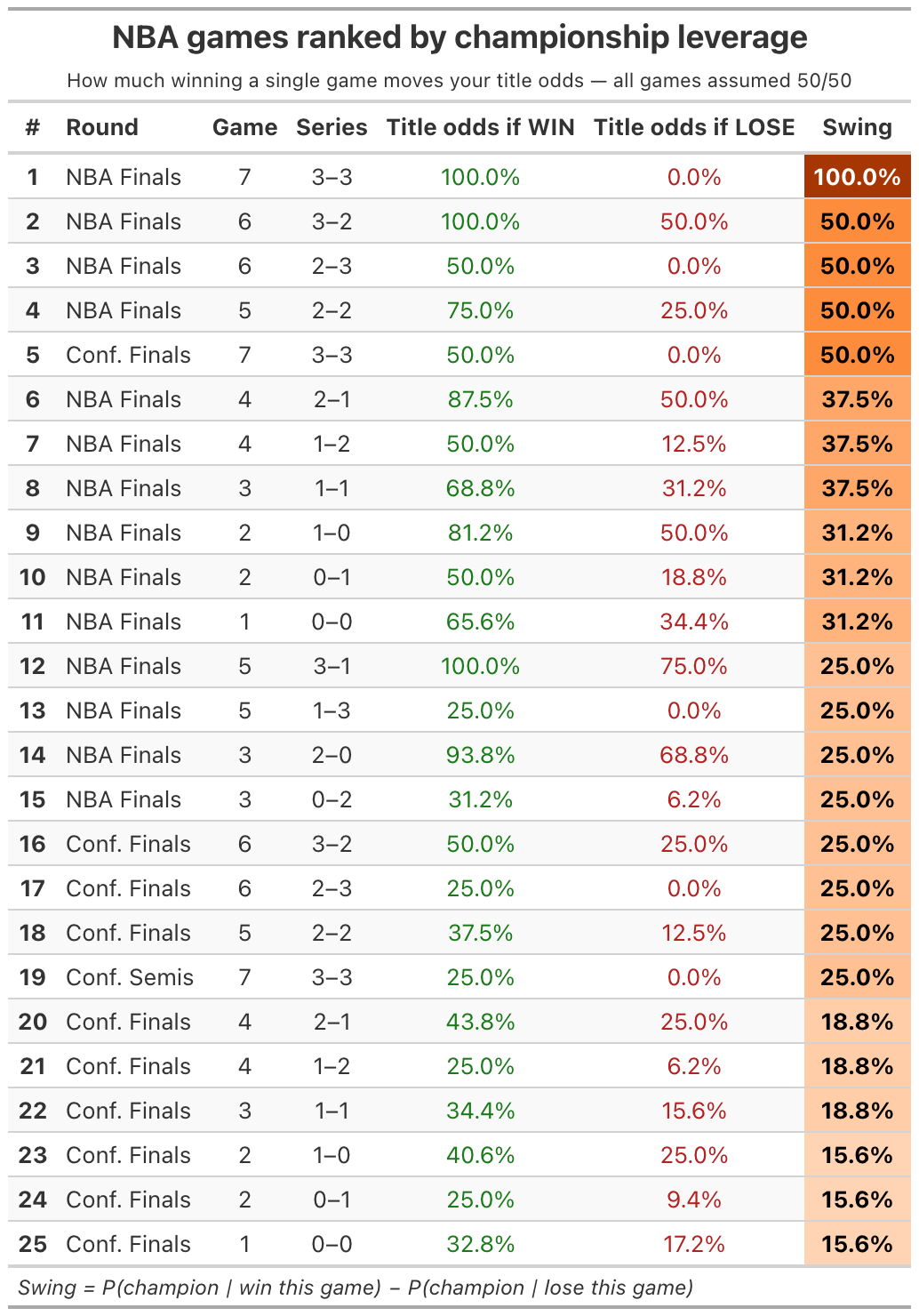
None of this is too surprising, with Game 7’s and Finals games ranked the highest. But it’s good to put a specific number on each game. Also note that winning a Game 7 in the Conference Finals has a bigger impact on your championship odds than winning any of the 1st 4 games of the Finals.
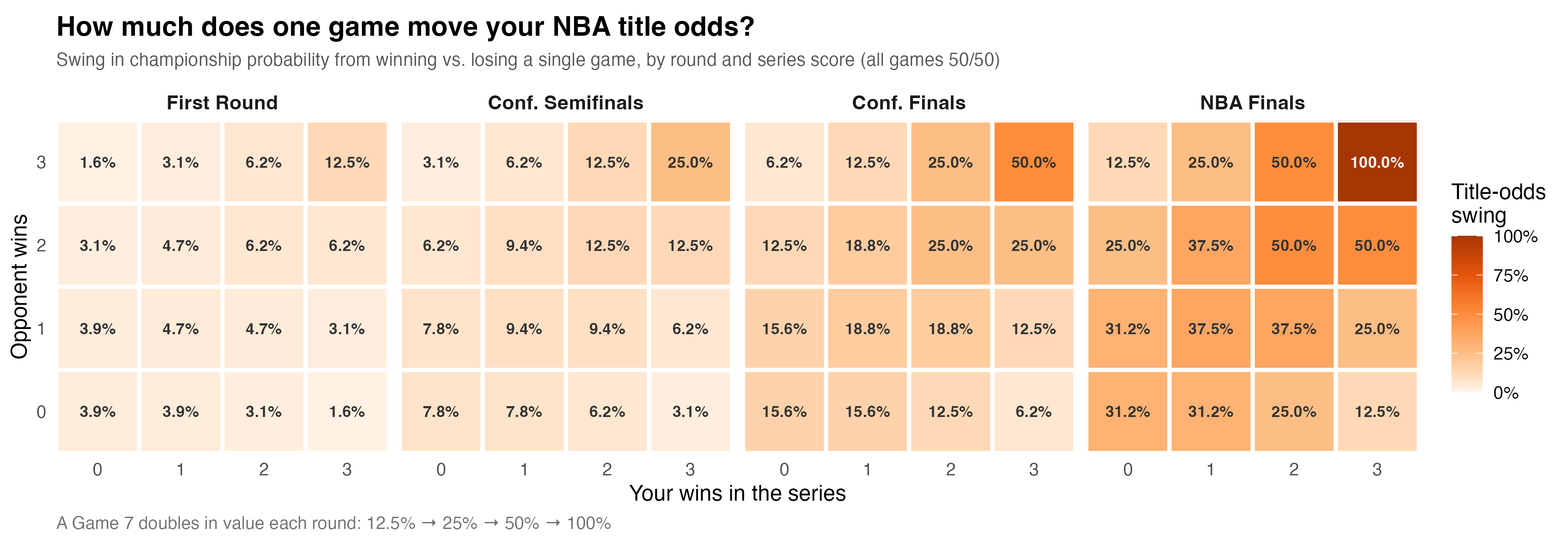
Here’s the swing factor for all potential playoff scenarios:
From win probability to championship probability
Armed with swing factors for each playoff game, we can now take every made shot in the playoffs and assess its impact not on just winning the game, but on winning the whole thing.
For each shot, we can quantify a team’s chances of winning the championship before the shot, and then after the shot. Typically, one would just subtract the two values to assess the impact on championship odds. However, as I found out most recently in my revamping of the NBA Excitement Index, probabilities aren’t really suited for simple subtraction such as this.
A better way of measuring the change in probability, one that is grounded in information theory, and has been shown to better align with our own intuitions regarding probability and surprise, is Kullback-Leibler divergence.
KL-divergence is a measure of “surprise” when going from one probability distribution to another. Crucially, it places much more value on probability changes where you’re clawing your way out of the tails of the distribution, rather than moving within the pudgy middle. For example, the KL-divergence of going from a 1% probability to a 11% probability is 0.244. But to go from 40% to 50% is just 0.029, despite both being a 10% additive shift in win probability.
The biggest shots of the past 30 years
And here’s the list. Like any good list, it has a nice balance of what you’d expect (Ray Allen, Kyrie) and some truly surprising entries: John Wall? A first round game? Derrick White at number 1?!??!?
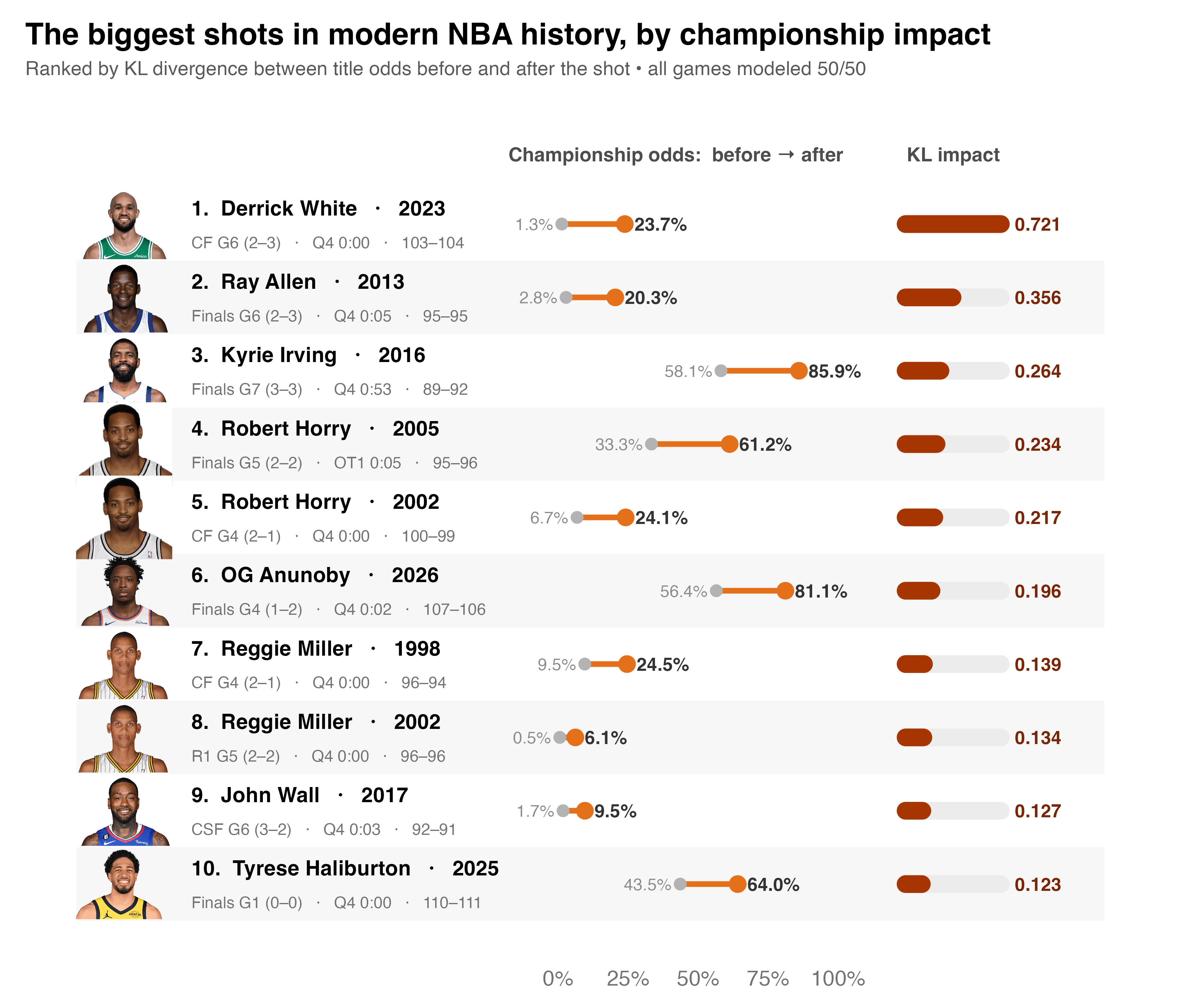
Like so many other clutch plays, Derrick White’s put back in Game 6 of the 2023 Conference Finals gets sort of memory-holed because of what happened afterwards2. In the ensuing Game 7 that Derrick White forced, the Celtics were blown out at home by Miami. But prior to his heroics, the Celtics were literally 0.1 seconds away from elimination. His shot single-handedly boosted their championship odds by twentyfold.
Ray Allen’s game tying three for the Heat being #2 makes sense, and would probably be the most popular choice for #1 in a general poll. Note that Ray Allen’s corner three would be much further down the list if we ranked these by difference in championship probability, rather then KL-divergence.
I imagine many would rank OG Anunoby’s tip-in higher than #6, but that may be due to it being the capstone on a 29 point comeback, and leading to an ultimately successful Finals run, neither of which is considered in this ranking.
I love that both Robert Horry and Reggie Miller show up here twice.
What these shots have in common is that they are all, save for one, made with just a few seconds (or no seconds) left on the clock, as this maximizes the in-game win probability swing. The exception is Kyrie Irving’s 3 pointer with 0:53 left, but that gets a sizable boost for being in Game 7 of the Finals.
Note that Reggie Miller’s 2002 shot in Game 5 of Round 1 was played when the first round was a best of 5 series, so this was effectively a Game 7.
Some notable examples that just missed the top 10:
Note that I was a contributor to a similar article by Ben Cohen in the Wall Street Journal from 2016, although I just provided my in-game win probabilities and the WSJ handled the translation to championship impact. And a lifetime of NBA iconic moments has happened in the past 10 years. For that original piece, Kyrie Irving’s 3 in Game 7 of the Finals was ranked as the top shot.
Ask Marcus Paige, Jermaine Kearse, or Tim Duncan
I had never heard of KL-divergence, that's fascinating! Awesome post.
Very interesting read. I think it's hard to rank simply assuming every game is 50/50, since momentum and narratives can swing so quickly, but this is definitely an interesting method to rank shots.